AI FOUNDATIONS · COURSE 05
THE AI INSTITUTE
Source-led executive learning · reviewed August 2026
What must change in the work for AI activity to become value?
A faster task is not yet a business result. Value appears only when released capacity, improved quality or new capability changes a workflow outcome that someone owns.
Your decision
By the end of this module, you will trace one AI-enabled task through the complementary workflow changes, measures and management decisions required to create a credible value hypothesis.
1. Begin with friction in a priority workflow
Tool-first proposals start with a product and search for places to install it. Decision-quality proposals begin with a workflow that matters: resolving a customer enquiry, preparing a proposal, replenishing stock or reviewing a control exception. Name the outcome, the people who receive it, the current steps and the friction that constrains performance. Only then ask whether an AI-enabled change is a proportionate intervention.
A task is one unit of work: draft a response, classify a message, extract a contract date. A workflow is the connected sequence that turns several tasks and hand-offs into an outcome. Improving a task may leave the workflow unchanged if the bottleneck sits elsewhere. A drafting assistant that produces copy in five minutes creates no customer value if legal review still waits ten days, the draft needs extensive correction, or salespeople use the released time for low-priority administration.
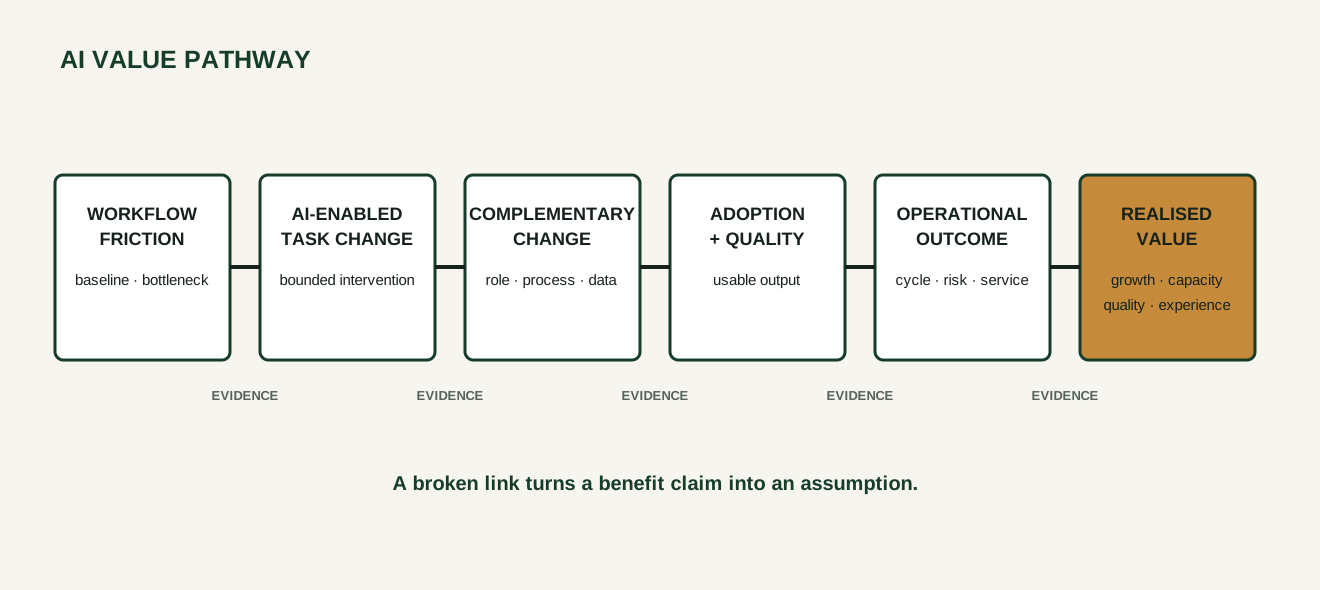
The first discipline is therefore causal: describe how a change in the task is expected to change the end-to-end workflow. Avoid the phrase “AI use case” until you can complete this sentence: For this group, changing this task and these surrounding practices should improve this outcome because…
2. Choose the value mechanism
Most business hypotheses use one or more of four mechanisms. Growth or revenue means the intervention helps win, retain or expand valuable demand. Cost or capacity means it reduces resources required for an outcome or releases capacity that can be deliberately redeployed. Risk or quality means it reduces material errors, losses, rework or variation. Experience or service means it improves timeliness, accessibility, relevance or effort for customers, employees or other stakeholders.
These mechanisms are not interchangeable. If the hypothesis is better service, minutes saved is at most an intermediate signal. If it is risk reduction, the right support may concern severe exceptions rather than average speed. If it is capacity, management must say what happens to the released hours. If it is revenue, adoption metrics do not prove conversion, retention or contribution margin.
Write one primary mechanism and, if necessary, one secondary mechanism. Listing every possible benefit weakens the hypothesis because no support could disconfirm it. A useful value statement exposes the causal bet: “By reducing the time advisers spend locating approved policy passages, we expect more same-day responses without reducing source accuracy.”
3. Released time is capacity inventory, not cash
Suppose 20 employees each complete ten reports per month. Drafting falls from 60 minutes to 40 minutes. The arithmetic suggests 20 people × 10 reports × 20 minutes = 4,000 minutes, or about 66.7 hours released per month. That number is not automatically a saving.
To become cash, paid hours or an external expense must actually fall without shifting cost or risk elsewhere. To become capacity value, the organisation must redirect those hours to named work, and that work must improve a measurable outcome. To become service value, the end-to-end cycle time or quality experienced by the recipient must improve. Small fragments of time may be difficult to redeploy; review work may increase; demand may vary; and adoption may be uneven. Record these leakages rather than treating every minute as fully fungible.
A credible capacity hypothesis therefore includes volume, time difference, adoption, quality and a redeployment decision. For example: “At 70 per cent sustained adoption, we estimate 47 gross hours released monthly. The proposal manager will redirect up to 30 usable hours to qualified customer discovery. We will track accepted draft quality and discovery meetings; we will not book a financial saving during the experiment.”
4. Complementary change is part of the intervention
An AI system rarely creates value alone. The intervention may require an approved information source, a revised intake form, new quality criteria, role clarity, exception handling, training, incentives or a changed approval threshold. These are not implementation footnotes. They are causal components of the value pathway.
A peer-reviewed field study of a generative AI assistant in customer support found that effects varied across workers in that setting [C005-S07]. Its population, task, treatment and operating context do not establish the same result elsewhere. Use published support to shape a local hypothesis, not to pre-fill its benefit number.
Ask three questions. First, what behaviour must the user change? Second, what must the manager or process owner change? Third, what dependency outside the team must change? If none of these changes is visible, the proposal probably describes product activity rather than operating value.
5. Measure the chain, not only the endpoint
A useful measurement set reveals where the pathway succeeds or leaks. Activity measures whether the system ran: drafts created or messages classified. Adoption measures whether intended users use it appropriately and persistently. Quality measures whether outputs meet the criteria needed for the workflow. Operational outcome measures the end-to-end result: cycle time, first-contact resolution, conversion, rework or severe exceptions. Value connects that outcome to an organisational consequence, with an owner who can validate the method.
Do not collect dozens of metrics. Select one or two at each material link and define them before the test. A baseline and comparator matter because a change over time can reflect seasonality, demand mix, staffing or another initiative. Segmentation matters because an average can conceal a team that receives no benefit or a category where quality fails.
| Link | Question | Example measure |
|---|---|---|
| Use | Did the intended practice occur? | Eligible proposals using the approved workflow |
| Quality | Was the output usable and safe? | Drafts accepted against the review rubric; critical source errors |
| Workflow | Did the end-to-end outcome change? | Median proposal cycle time by segment |
| Value | Was released capacity or quality converted? | Qualified customer hours completed; conversion quality |
6. Worked case: proposal drafting assistant
Composite teaching case
A business-services team proposes an assistant to draft the first version of client proposals from approved service descriptions and de-identified discovery notes. The initial test shows median drafting time falling from 90 to 55 minutes. The sponsor calls this a 39 per cent cost reduction.
The team challenges the conclusion. Review time rose by ten minutes because source and scope checks were not built into the template. Only half of advisers used the assistant consistently. Proposal approval still waited in a shared queue. No labour or supplier cost changed. The gross task-time result was real, but the value claim crossed three unproven links.
The team redesigns the intervention: an approved proposal structure, source-linked service statements, a review rubric, a 24-hour manager review window and scheduled redirection of usable capacity to customer discovery. The primary mechanism becomes capacity-to-growth, not immediate cost reduction. Measures include eligible-use adoption, accepted-first-draft rate, total cycle time, qualified discovery hours and proposal conversion by segment. The proposal manager owns capacity redirection; the sales director owns the conversion interpretation.
What changed?
The technology did not change. The workflow, quality standard, review service level, redeployment decision and benefit ownership changed. These additions turn a task-speed observation into a testable value pathway.
7. Contrast case: every saved minute becomes cash
Misconception
A business case multiplies the time saved in a five-person demonstration by every employee, every workday and the fully loaded hourly rate. It assumes 100 per cent adoption, unchanged quality, no review effort, perfectly reusable time and immediate financial conversion. The finance team is shown one large annual number with no owner or review gate.
This calculation may describe a theoretical ceiling. It is not a forecast. Keep it only if it is labelled as a gross potential, then model adoption, task eligibility, quality, review effort and usable capacity. State whether the decision concerns cash, capacity, risk, service or learning. Assign a value-realisation owner who can act on released capacity rather than merely report it.
8. Practice: build the pathway
Produce support
Use the value pathway map for one de-identified workflow. Record: current friction and baseline; AI-enabled task change; complementary process, role or data change; primary value mechanism; adoption and quality support; operational outcome; value decision; and owner. Add one leakage assumption and one stop or revise threshold.
Completion support: a value pathway with a named baseline, no missing causal link, one outcome measure and a manager who owns value conversion.
Download editable value pathway map (CSV)9. Decision summary
A task improvement becomes organisational value only through a chain of complementary changes and decisions. Make the chain visible. Distinguish gross capacity from usable capacity and cash. Measure adoption and quality so you can diagnose failure. Give the benefit to an owner with authority to redirect work, change the workflow or stop the intervention.
Transfer prompt
Use the manager discussion guide with the owner of one priority workflow. Do not request confidential commercial numbers in Moodle or the Learning Partner; use categories or de-identified ranges.
Review the annotated exemplar Open the manager discussion guide