AI FOUNDATIONS · COURSE 05
THE AI INSTITUTE
Source-led executive learning · reviewed August 2026
Which opportunity deserves the next dollar and hour?
The best first experiment is rarely the idea with the largest theoretical prize. It is the bounded opportunity that can produce useful support safely, quickly and reversibly.
Your decision
By the end of this module, you will compare three opportunities, expose the support behind each score, test whether the ranking survives uncertainty, and record one proportionate first choice.
1. Frame the problem before the product
“Deploy a copilot” is a solution. “Proposal teams spend too much time locating approved service support, which delays qualified responses” is a problem statement. A useful opportunity frame names a workflow, affected group, current friction, baseline, decision owner and value mechanism. It remains meaningful if the preferred product disappears tomorrow.
Tool-first shortlists inherit vendor categories and create false urgency. Problem-first shortlists allow leaders to compare an AI-enabled intervention with process repair, better data, training or no action. Sometimes the best first step is to fix an intake form or content owner before testing a model. Dependencies are findings, not inconveniences to hide.
Write each candidate at the same level of specificity. Comparing “transform customer service” with “draft a weekly summary for analyst review” guarantees a distorted result. Give each candidate a bounded task, workflow outcome, population and excluded decision.
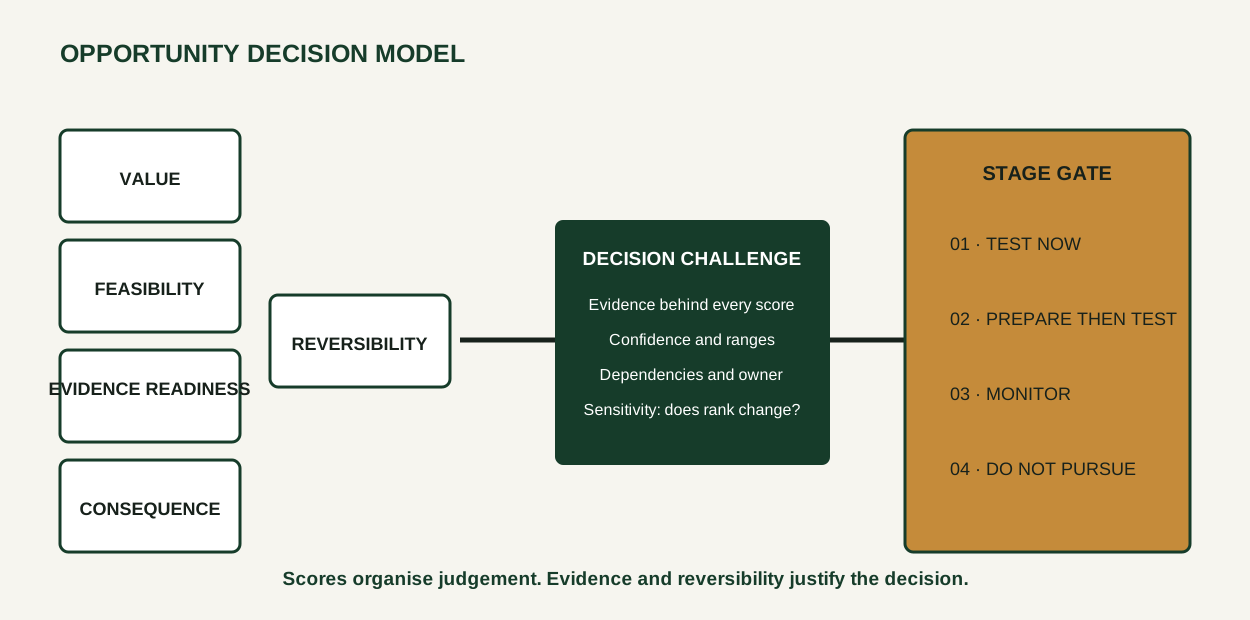
2. Compare five lenses
Value asks whether the workflow outcome matters and whether a credible mechanism connects task change to growth, capacity, risk, quality or experience. Use the Module 2 pathway, not a generic benefit adjective.
Feasibility asks whether the task is sufficiently bounded, the technology can plausibly perform it, integration and operating changes are achievable, and an owner can support the test. Feasibility is not a vendor feature list.
Support readiness asks whether a baseline, representative tasks, quality criteria, permitted data and reviewers exist or can be assembled proportionately. A promising task may not be ready if no one owns the source material or can recognise a good output.
Consequence asks what happens when the system or workflow is wrong, misused or unavailable, who is affected, and how detectable and correctable the error is. High consequence does not mean “never”; it means greater control cost and often a poor first learning experiment.
Reversibility and learning asks whether the organisation can run a contained test, observe the material uncertainties and stop without leaving people, data or operations exposed. A lower-value but highly reversible test can be the better first move when it builds capabilities needed for later opportunities.
3. Score support, not enthusiasm
A one-to-five scale can structure discussion, but arithmetic does not remove judgement. Every score needs a short support note and confidence rating. “Value 5” without a baseline or pathway is an opinion wearing a number. Use ranges when uncertainty is material: value may be two to four until task volume is confirmed.
Keep consequence visible rather than subtracting it invisibly from value. A high-value, high-consequence idea can appear in the portfolio while failing the first-experiment gate. Likewise, feasibility should include complementary process and control work, not only whether a demonstration is technically possible.
Weights reflect strategy and can manipulate the winner. Record why a weight matters, show the unweighted support and run a sensitivity check. Change one uncertain score or weight within a plausible range. If the winner changes, the decision is fragile and the next action should resolve that uncertainty rather than pretend the ranking is precise.
4. Identify dependencies and enabling moves
An opportunity can be valuable but blocked by missing source ownership, inconsistent process, unclear permissions, no baseline, unavailable reviewers or a critical integration. Mark each dependency with an owner, support needed and earliest resolution date. Do not bury it in an implementation appendix.
Some dependencies create portfolio value. Cleaning the approved policy corpus may enable several assistants. Defining a quality rubric may improve current work even if the AI test stops. Prefer first moves that create reusable support, governance practice or data capability without locking the organisation into scale.
5. Use a stage gate rather than a permanent verdict
The decision is not simply yes or no. It may be test now, prepare then test, monitor, or do not pursue. “Prepare” needs a bounded enabling action; “monitor” needs a trigger and owner; “do not pursue” needs a reason and review condition if circumstances could change.
A first experiment should target the uncertainty most likely to change the decision. If output quality is unknown, test representative tasks before integrating the workflow. If adoption is uncertain, prototype the practice with users. If consequence is high and controls are immature, choose a lower-consequence analogue that develops evaluation and oversight capability.
6. Worked comparison: three opportunities
Composite teaching case
A 600-person organisation compares three candidates.
A. Internal knowledge assistant: source-linked draft answers for service staff using an approved corpus. Moderate value, moderate feasibility, good support readiness after a content-owner gap is resolved, low-to-moderate consequence because an authorised employee verifies before response, and high reversibility.
B. Customer recommendation engine: personalised next-best offers. High potential value, but weak baseline, complex integration, unclear consent and measurement, and moderate consequence. The opportunity needs preparation.
C. Hiring-screening recommendation: rank applicants. Potential capacity value, but high consequence for affected people, weak representativeness support, significant contestability and assurance needs, and low reversibility once applicants are affected.
The simple value score favours B and C. The first-experiment decision favours A after a two-week source-ownership action. A can test retrieval, citation verification, staff adoption and escalation in a bounded workflow. It also builds evaluation and governance capability. B is marked prepare then test; C is not pursued until necessity, alternatives, support and affected-person protections receive specialist review.
7. Contrast case: competitor announcement as strategy
Misconception
A vendor presents a polished demonstration and a competitor press release. Leaders give the idea five for value and five for feasibility. No workflow baseline, data permission, quality criterion, consequence review or owner appears. The scorecard totals 25 and the team calls it objective.
The score is an enthusiasm record. Reframe the problem, separate findings from assumptions, add consequence and reversibility, and test sensitivity. If no support supports a criterion, record “unknown” and design the next support action.
8. Practice: rank, challenge, decide
Produce support
Use the opportunity matrix for three de-identified candidates. Provide support and confidence for every lens. Identify dependencies, change one uncertain input, and record whether the ranking changes. Select a gate and the support action that would change the next decision.
Completion support: three comparable problem frames, no unsupported score, one sensitivity result, one dependency owner and a written test/prepare/monitor/do-not-pursue decision.
Download editable opportunity matrix (CSV)9. Decision summary
Choose the opportunity that creates the most decision-relevant learning at proportionate cost and consequence. Make assumptions visible, reward reversibility, resolve enabling dependencies and keep high-potential ideas in a staged portfolio without confusing theoretical value with readiness.
Transfer prompt
Ask your sponsor: “Which uncertain assumption, if false, would change this ranking?” Use de-identified ranges and roles. Do not enter vendor-confidential or commercially sensitive information in Moodle or the Learning Partner.